Buddha Park (Wat Xieng Khouane Luang)

Vientiane · Laos

Buddha Park (Wat Xieng Khouane Luang)

When concrete gives shape to the gods, and the Mekong banks hum a rhapsody.

Discover Vientiane, Laos's most surreal garden — over 200 giant sculptures blending Buddhism and Hinduism, on the Mekong's south bank.

View on Google Maps 17.9124°N, 102.7622°E · Deua, Vientiane Vientiane attractions Wat Xieng Khouane Luang · ວັດຊຽງຄູນ
★ 4.3 5,456 Google

Rating and review count synced from Google Maps user reviews · September 2026 · View all Google Maps reviews ↗

Vientiane attractions

Buddha Park

Wat Xieng Khouane Luang · ວັດຊຽງຄູນ

Sun & sky planner Live
🌦️ Times are estimates for the park's location
31°
Partly cloudy
💨 8 km/h
☀️ Tonight's sky

Soft sunset

Sun & sky planner

Times are estimates for the park's location

Golden hour17:35 – 18:05
Sunset18:25
Blue hour18:45 – 19:15
CrowdsQuietest in the morning

Live conditions measured at the park's own coordinates

About the park

About Buddha Park (Wat Xieng Khouane Luang)

Where the Mekong meets 200 statues

Welcome to Buddha Park (Wat Xieng Khouane Luang), widely recognized as the Buddha Park of Vientiane. Located in Deua, Vientiane, Vientiane Capital, Laos, this riverside sculpture garden serves as one of the primary landmarks for travellers visiting the capital region.

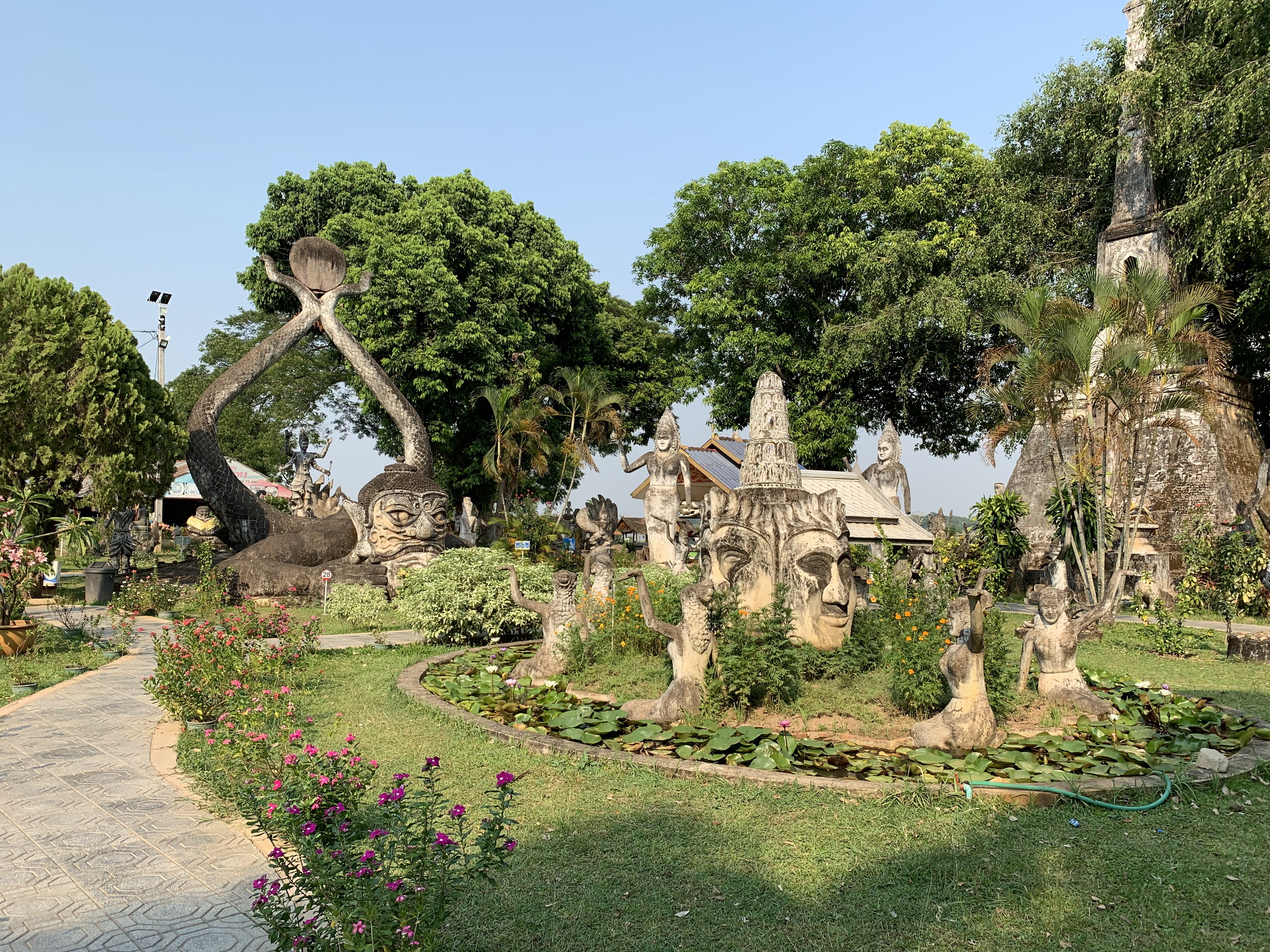
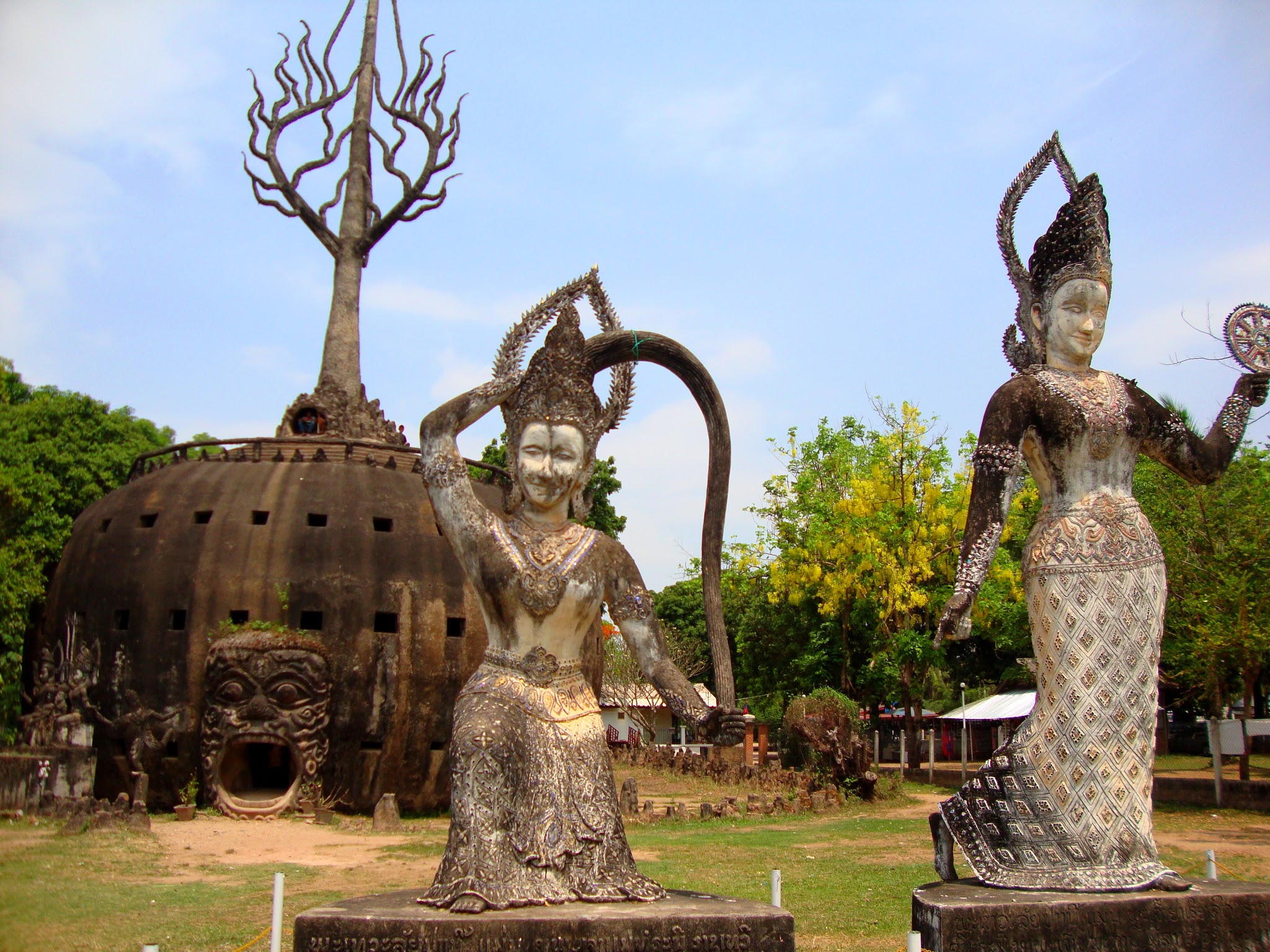
Buddha Park (Wat Xieng Khouane Luang) is a sculptural garden on the eastern bank of the Mekong, just outside Vientiane — a quiet, otherworldly place where Buddhism and Hinduism share the same lawn.

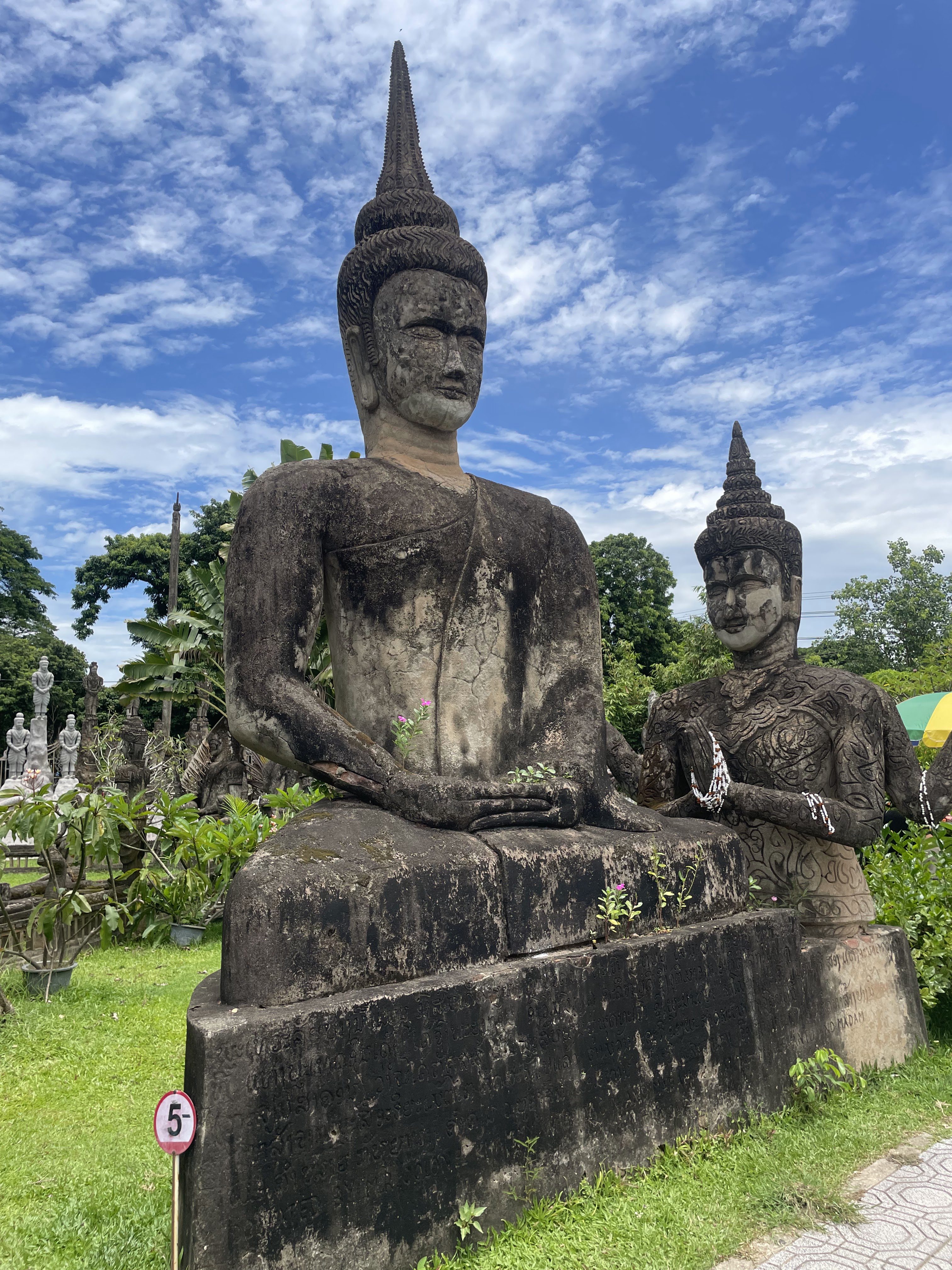
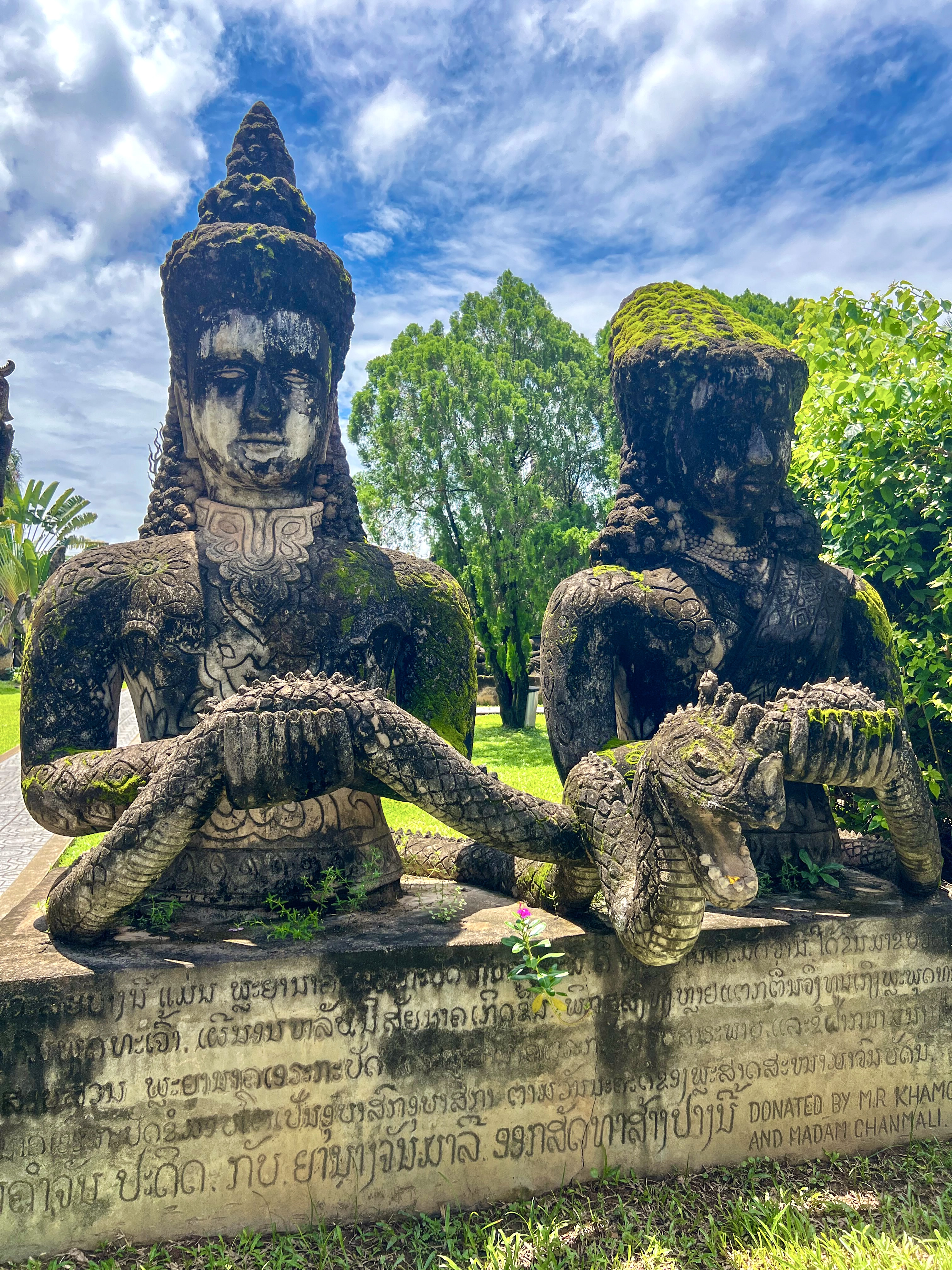
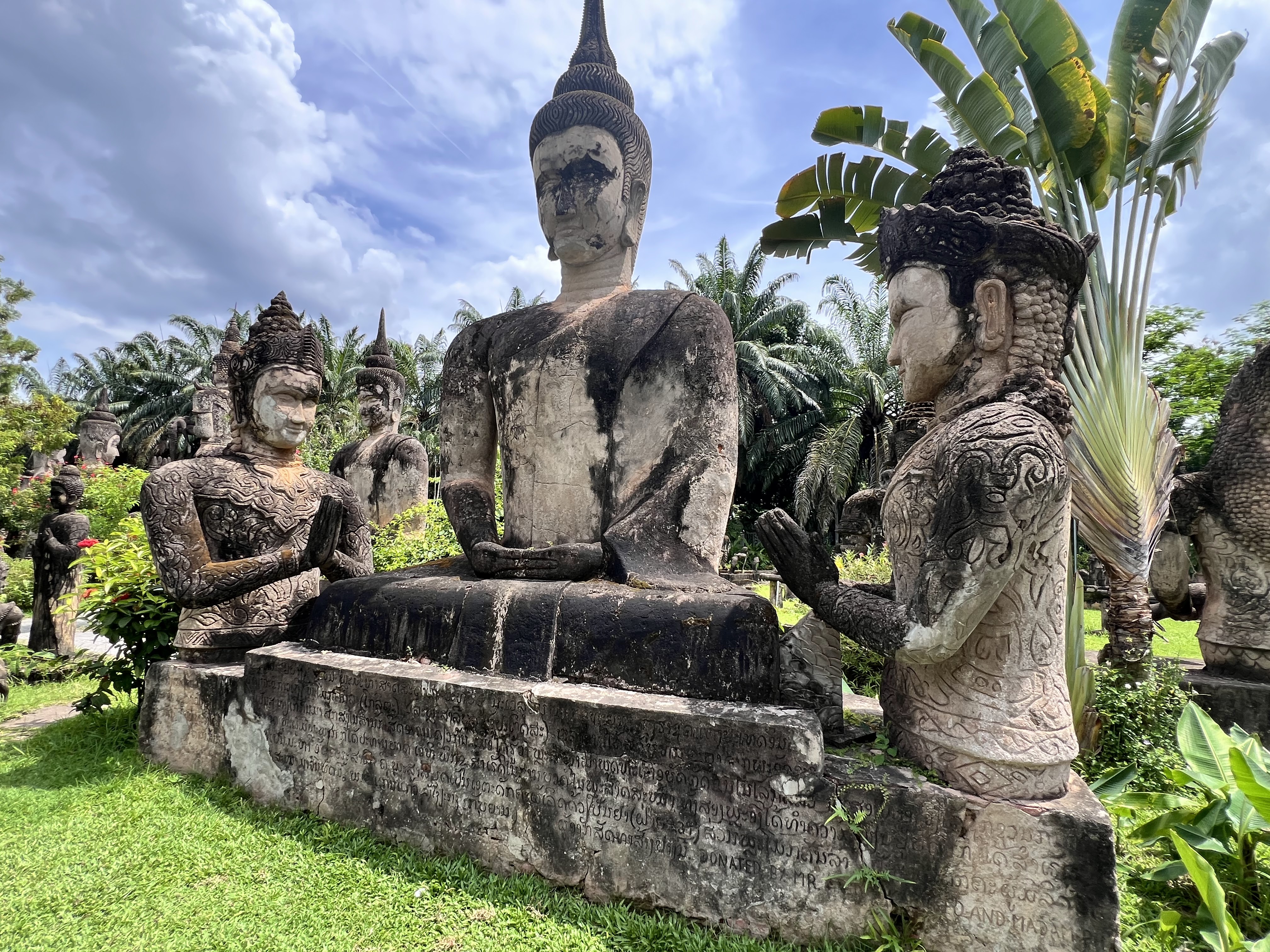
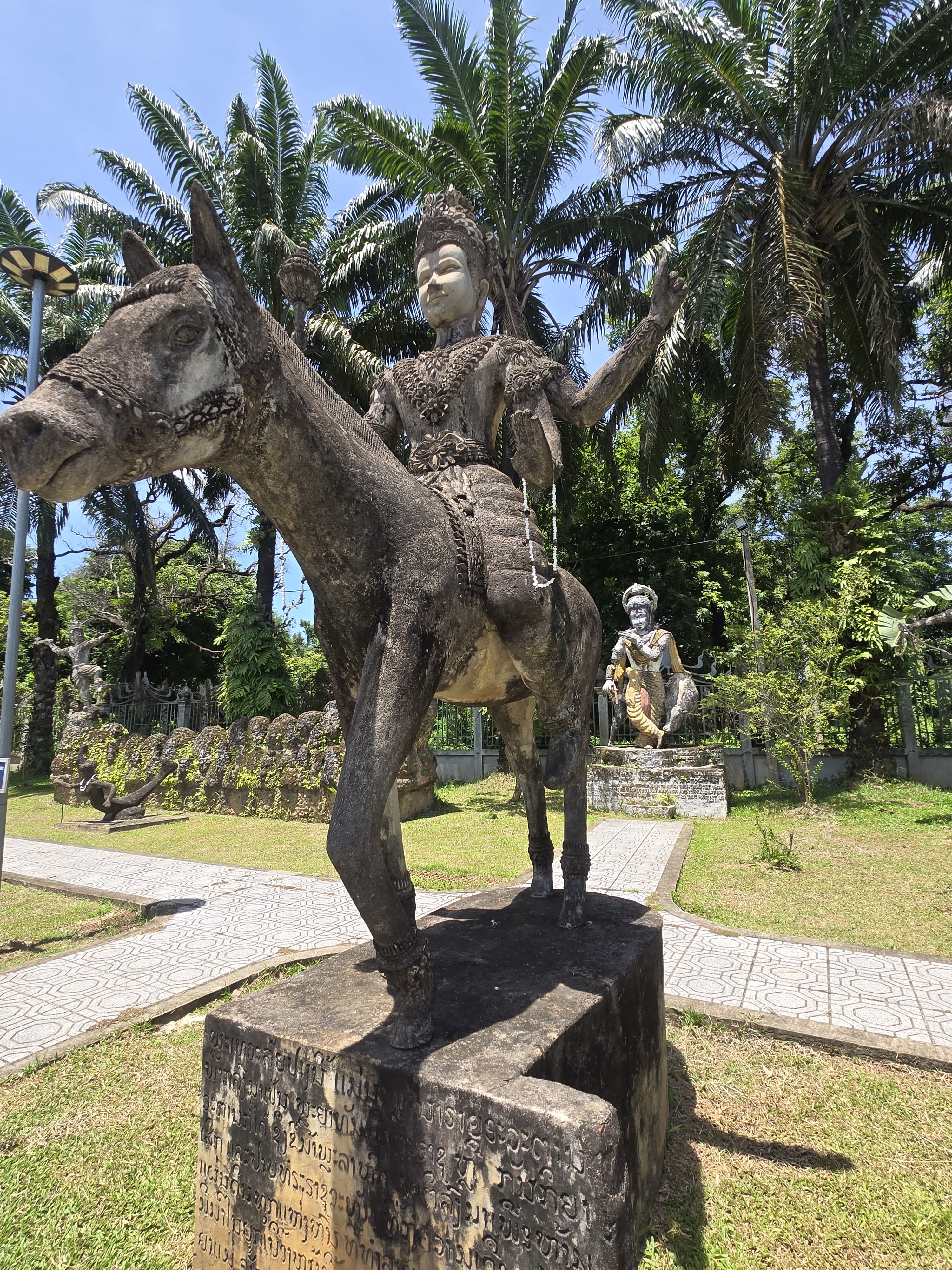
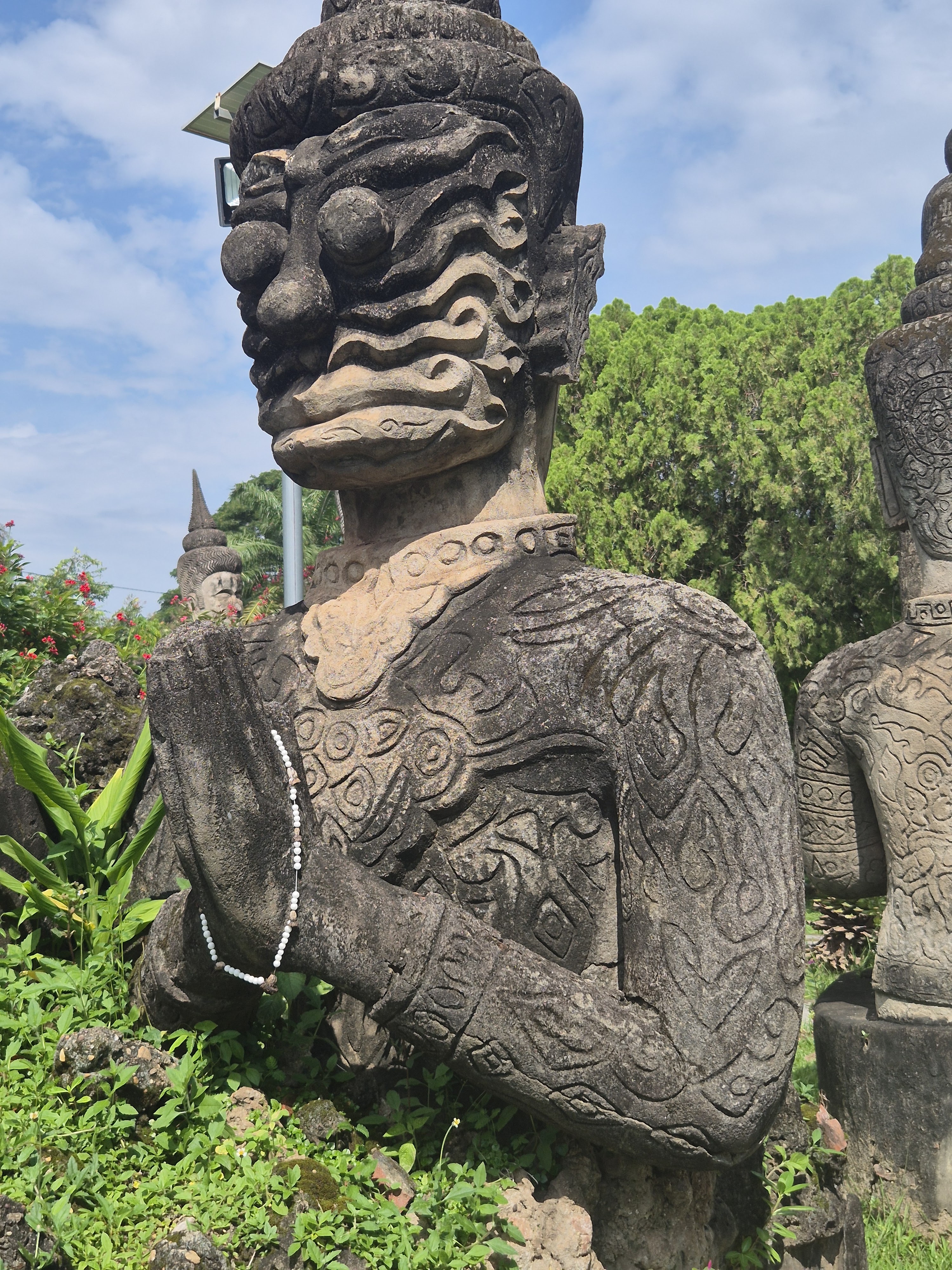
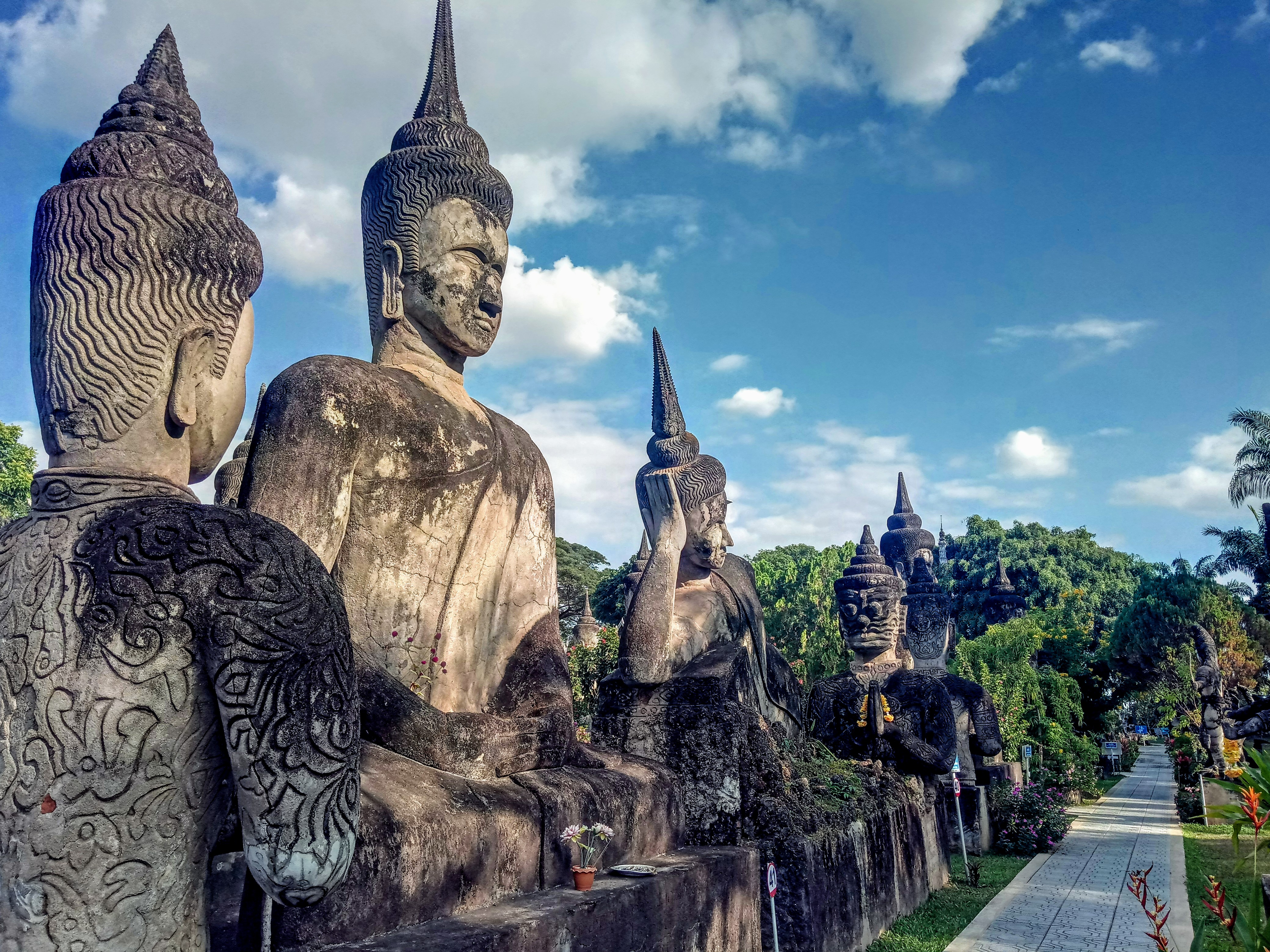
The park was founded in 1958 by Luang Pu Bunleua Sulilat, a mystic priest who studied both Buddhist and Hindu teaching. He gathered local craftsmen to mould more than 200 statues in reinforced concrete, blending the two faiths into one riverside garden.

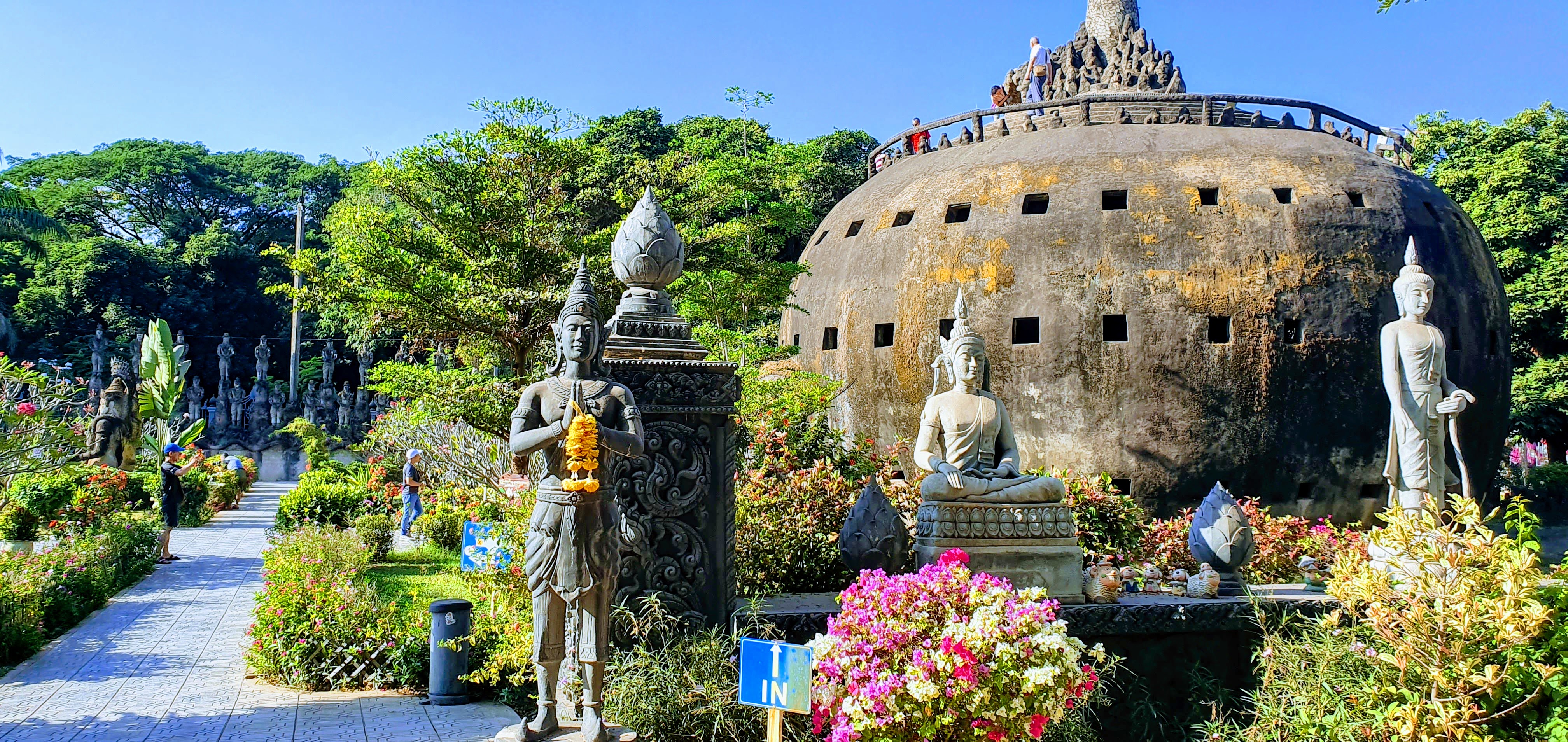
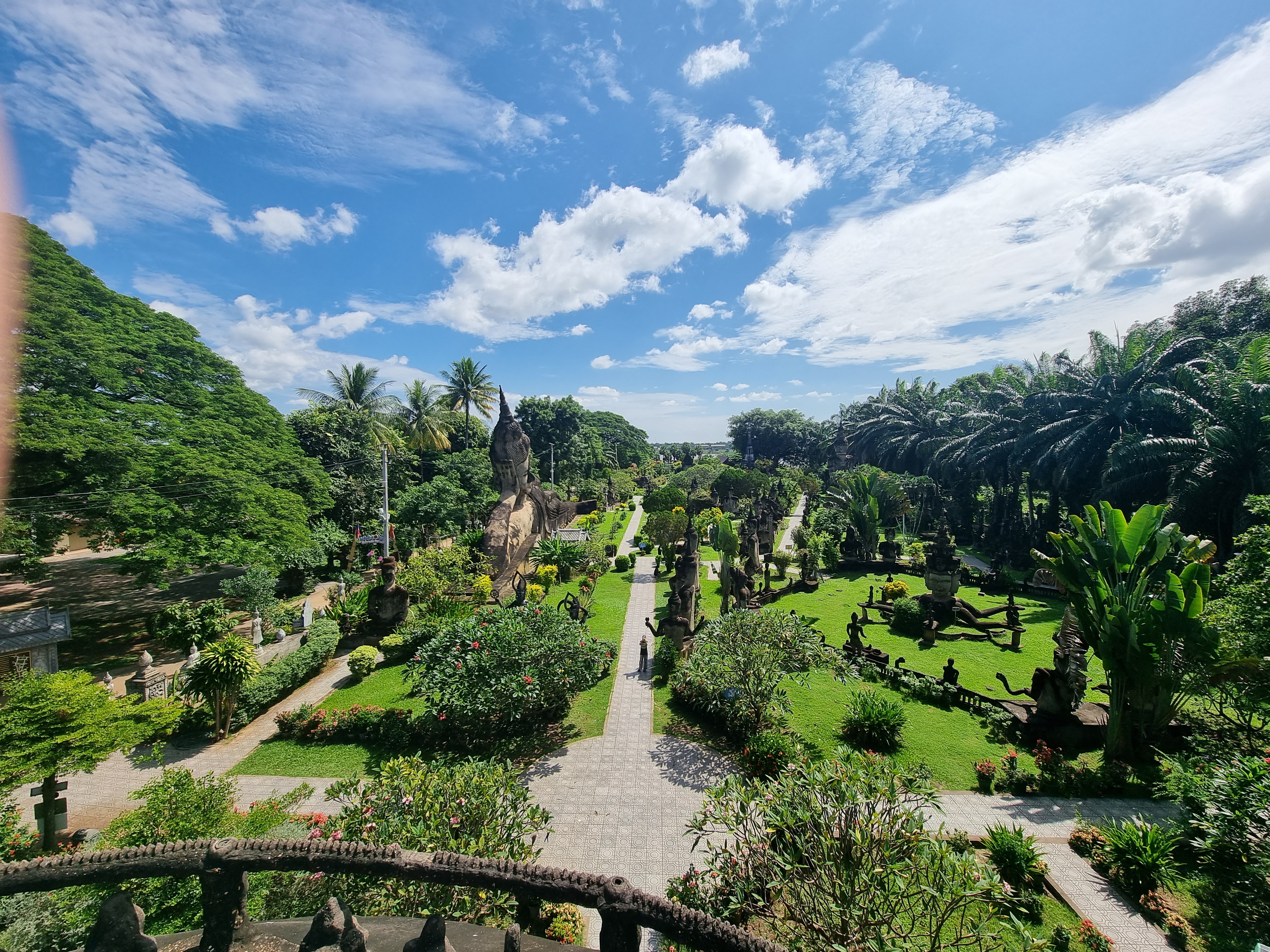
Today Buddha Park is one of Vientiane's most surreal stops. Wandering between a 40-metre reclining Buddha, a giant pumpkin you climb from Hell to Heaven, and a three-headed elephant is unlike anywhere else in Laos.

When visiting Buddha Park (Wat Xieng Khouane Luang), visitors can easily explore surrounding historical landmarks and points of interest, including Pha That Luang and Patuxai.

“Walk slowly — the park reveals itself one statue at a time.”
— a regular visitor
200+
Concrete statues
1958
Founded
08:00
Opens
🎃
The Three Realms Tower (Pumpkin)
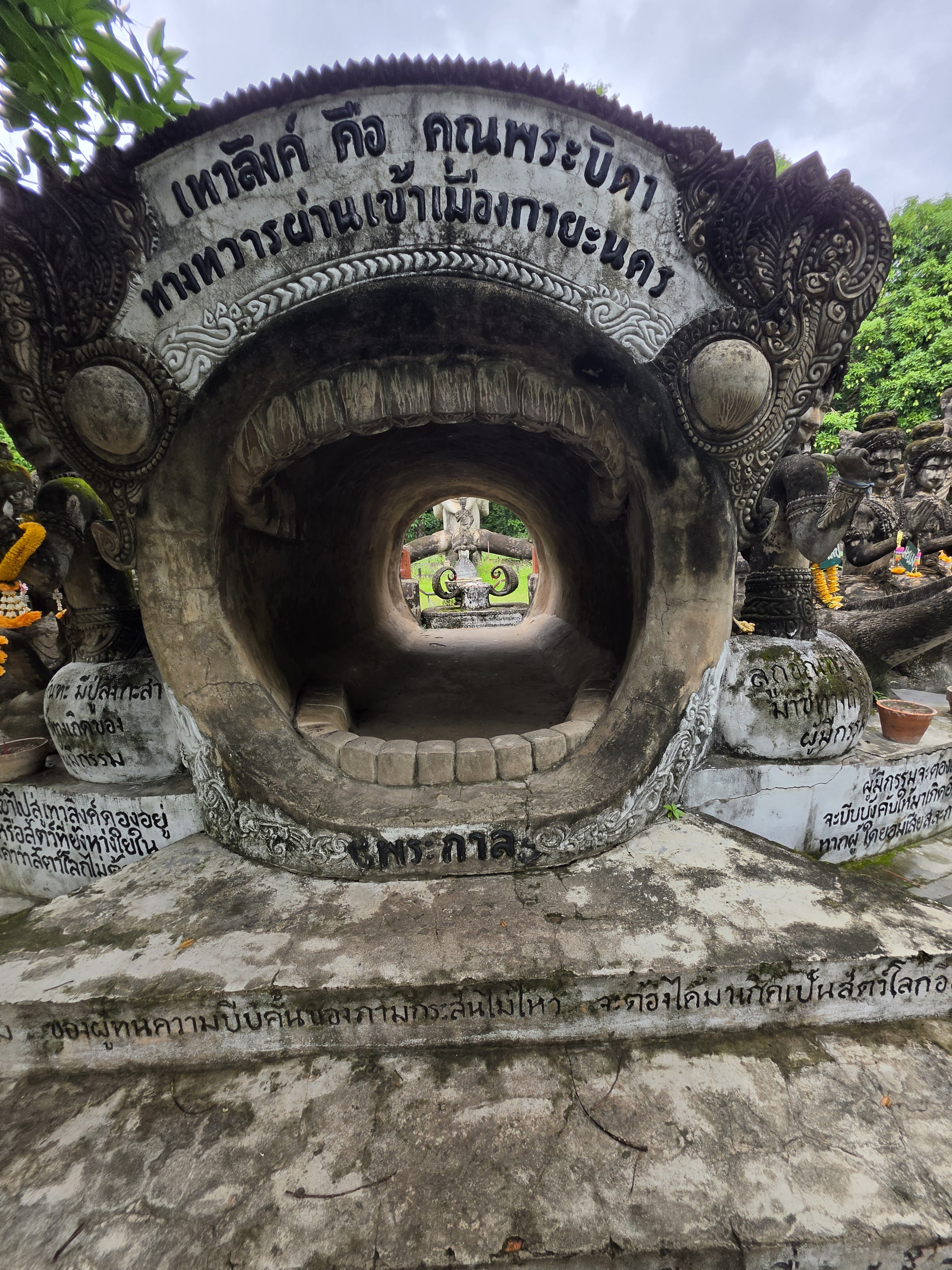
Enter the demon's mouth, climb narrow stone steps in the dark through Hell and the human world, and finally reach the light at the top, overlooking the whole spirit-city by the Mekong.
🛕
Reclining Buddha
A 40-metre sleeping Buddha, among the largest in Laos.
🐘
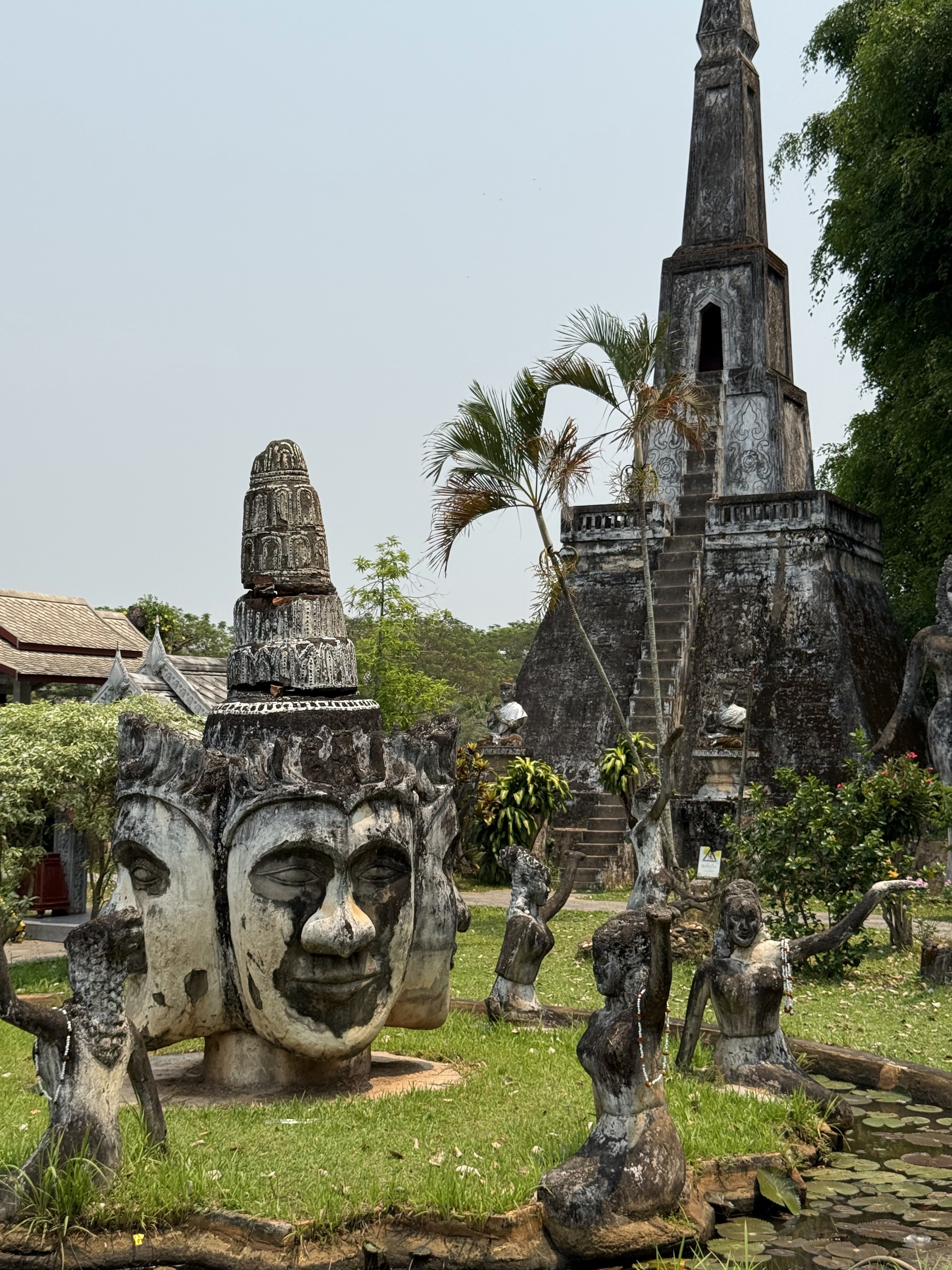
Three-headed elephant
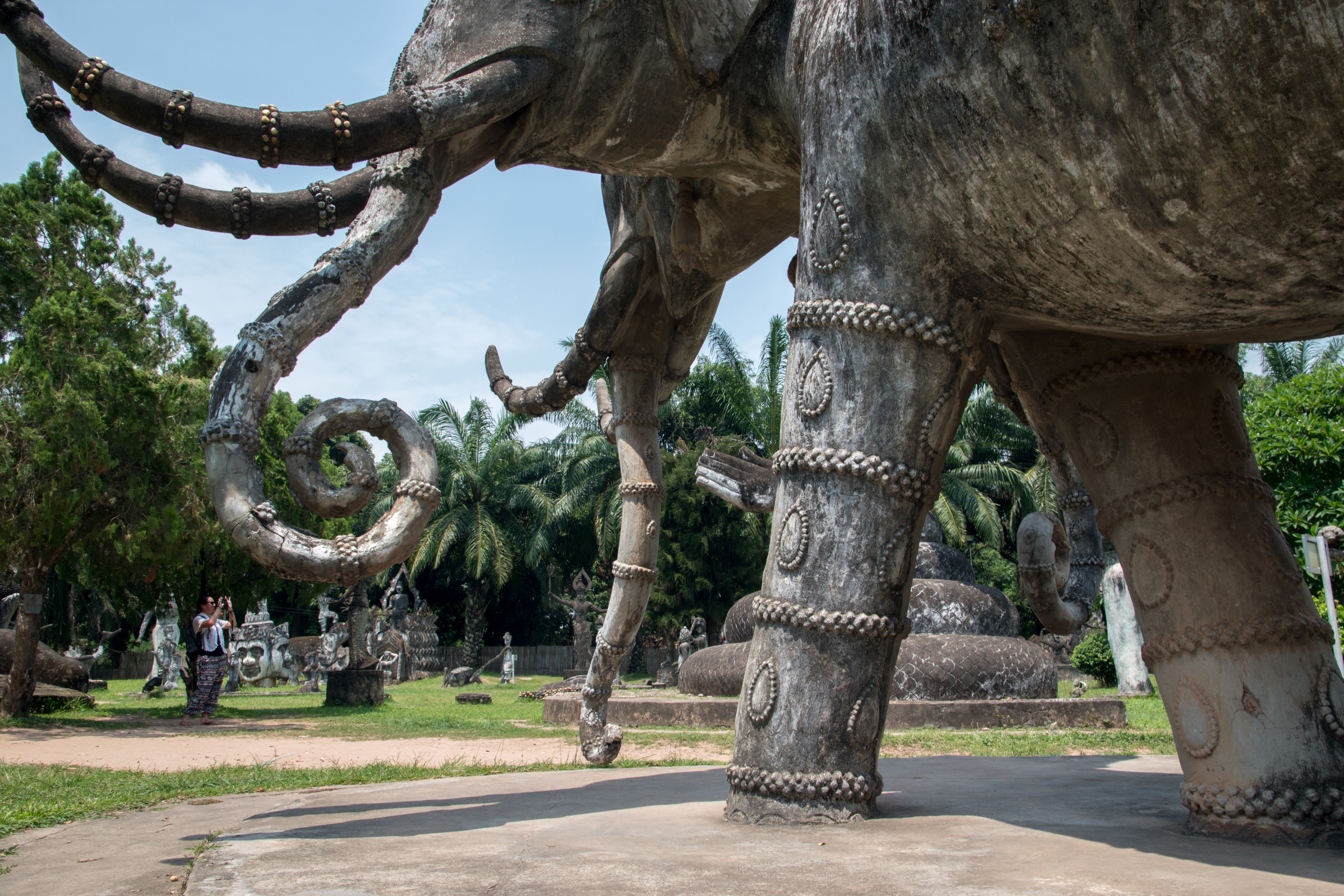
The park's emblem — Erawan rising above the earth.
Editor's tip

Arrive around 08:30 to beat the heat and group tours, then linger until the light softens.

See full guide →

Visitor guide

Location & How to Visit Buddha Park in Vientiane

Everything you need before you go

Straightforward, useful advice for a relaxed half-day at Buddha Park.

Two ways to enjoy it

Pick your pace — wander slowly or climb the pumpkin.

Walk the lawns
Easy

Pace:Easy· Flat paths

Families, photographers

Stroll between statues, rest in the shade, watch the Mekong.

Climb the pumpkin
Easy

Pace:Easy· Three floors

First-timers, curious minds

Enter the demon's mouth and climb from Hell to Heaven for the rooftop view.

⚠️ Straight talk

Entry fees are posted at the gate — pay at the booth and keep small cash for the camera fee and drinks.

🕒 Best time to go

08:00 – 17:00 (daily)

  • Opens08:00
  • Best light08:00 – 10:00
  • QuietestMorning
  • Closes17:00
💸 Costs

Costs

  • Entry
    About 15,000 LAK for foreign visitors
  • Camera fee
    Around 5,000 LAK if you bring a camera
  • Food & drinks
    Small stalls sell water and snacks

Ticket prices may be adjusted slightly by local policy; we recommend carrying some Thai baht (THB) or Lao kip (LAK) cash.

🚌 Getting there

How to reach Buddha Park

  • From Vientiane
    About 25 km east of the centre; tuk-tuk or bus toward the Thai–Lao Friendship Bridge.
  • Local bus
    Public buses run from the capital's bus stations to the Deua / Friendship Bridge road.
  • From Nong Khai, Thailand
    Cross the river by the Friendship Bridge, then continue to the park on the Lao side.
  • Bus No. 14
    From Talat Sao Bus Terminal in Vientiane, take Bus No. 14 — its final stop is Buddha Park. Fare is about 6,000 LAK, the cheapest and most classic public transport for backpackers.
  • From Wattay International Airport (VTE)
    Wattay International Airport is about 30 km from the park. Take an airport taxi or a ride-hailing app to the city or the park (around 40–60 min), or save money by heading to Talat Sao first and catching Bus No. 14.

Photography guide

The park is most photogenic in soft morning light.

Best light

Golden hour

~08:00–09:30 — warm light on the statues and river

Blue hour

~18:00–18:40 — soft sky before closing

Early morning

07:30–08:30 — mist and few people

Photo spots

The giant pumpkin top

Rooftop view over the park and Mekong

Climb before the crowds

Reclining Buddha

40-metre silhouette

Shoot low from the side

Three-headed elephant

The park's emblem

Use a wide angle

Camera settings

Golden hour

f/8, ISO 100, 1/250s

Tap to expose for the sky, enable HDR

Blue hour

f/5.6, ISO 400, 1/60s

Night mode, hold steady 2–3s

Reflections

Polariser, low tripod

Get close to the water's edge

Quick tips

  • Arrive 30 min after opening
  • Shoot toward the open river
  • Wipe the lens if there's mist
  • Respect the quiet of the shrines

Best time to visit

Vientiane has three seasons that change the park's mood.

❄️ Nov – Feb

Cool season

Pleasant mornings and the clearest light — the most comfortable time to walk.

🔥 Mar – Apr

Hot season

Very warm; come in the first hours to avoid the heat.

🌧️ May – Oct

Wet season

Green lawns and few visitors, but afternoon rain may shorten a visit.

Safety

  • Near statues — Some concrete is old; don't climb fragile figures.
  • The pumpkin stairs — Steps are narrow inside; hold the rail and watch your head.
  • Personal items — Keep bags close at the busy gate area.

🌫️ Hot & smoky months

March–April can be very hot and hazy; travellers sensitive to heat may prefer December–January.

Emergency numbers

For urgent help in Laos:

Accessible for everyone

The main lawns are flat with few steps.

  • Wheelchairs & prams — Flat paths around most of the lawn.
  • Resting — Shaded benches and a small café.
  • Toilets — Public facilities near the entrance.

Frequently asked questions

What are the opening hours of Buddha Park? +

The park is open daily about 08:00–17:00. Mornings are coolest and quietest.

How much is the entrance fee for Buddha Park Vientiane? +

Yes — about 15,000 LAK for foreign visitors, plus around 5,000 LAK if you bring a camera.

How do I get to Buddha Park from central Vientiane? +

It's about 25 km east of the centre; take a tuk-tuk or public bus toward the Friendship Bridge.

Is the giant pumpkin worth climbing? +

Yes — the three-storey sphere climbs from Hell to Heaven, with a rooftop view over the Mekong.

Is it good for families? +

Very — flat lawns, a riverside walk and the playful statues, but watch children on the narrow pumpkin stairs.

Where is Buddha Park located? +

Buddha Park (Wat Xieng Khouane Luang) is located in Deua, Thanon Tha District, Vientiane, Vientiane Capital, Laos — about 25 km east of the city centre on the Mekong's south bank. Plus Code: WQ67+WW.

How long does a visit to Buddha Park take? +

Most visitors spend 1–2 hours. Walking the lawns and climbing the three-storey pumpkin tower fits comfortably into a half-day trip from Vientiane.

What should I wear when visiting Buddha Park? +

It is an active religious site: cover shoulders and knees, remove shoes where asked, and bring a hat, sunscreen and water — the concrete lawns get very hot at midday.

Can I fly a drone at Buddha Park? +

Drone rules in Laos require permission from the authorities, and parks near the Mekong and the Friendship Bridge are sensitive areas. Assume you need written permission before flying, and ask at the entrance if you are unsure.

Is Buddha Park wheelchair accessible? +

The main lawns are flat and mostly firm, so wheelchairs and prams can reach many of the large statues. The giant pumpkin's inner stair is narrow, dark and steep, so the upper levels are not accessible.

How is Buddha Park different from Sala Keoku in Nong Khai? +

Both were created by the same mystic, Luang Pu Bunleua Sulilat, and both mix Hindu and Buddhist figures in concrete. Buddha Park came first in 1958 on the Lao bank; Sala Keoku followed after 1975 on the Thai bank, with taller and more elaborate structures. Many visitors see both on one cross-border trip.

Who built Buddha Park and why? +

Luang Pu Bunleua Sulilat, a shamanic recluse who blended Buddhist and Hindu ideas, began the park in 1958 as a way to express his vision in concrete rather than words.

Sculpture guide

Six figures you should not miss

More than 200 concrete figures share these lawns. These six carry the stories visitors ask about most — with the best angle for photographing each one.

Landmark

The Giant Pumpkin

Three levels: hell, earth, heaven

A bulbous tower you enter through the jaws of a demon. The narrow stair climbs past scenes of hell, through the human realm, and out onto a rooftop terrace standing for heaven.

📷 Shoot upward at the demon's mouth from the base, then from the rooftop terrace for the only full-park panorama.

Landmark

The Reclining Buddha

Roughly 40 m long

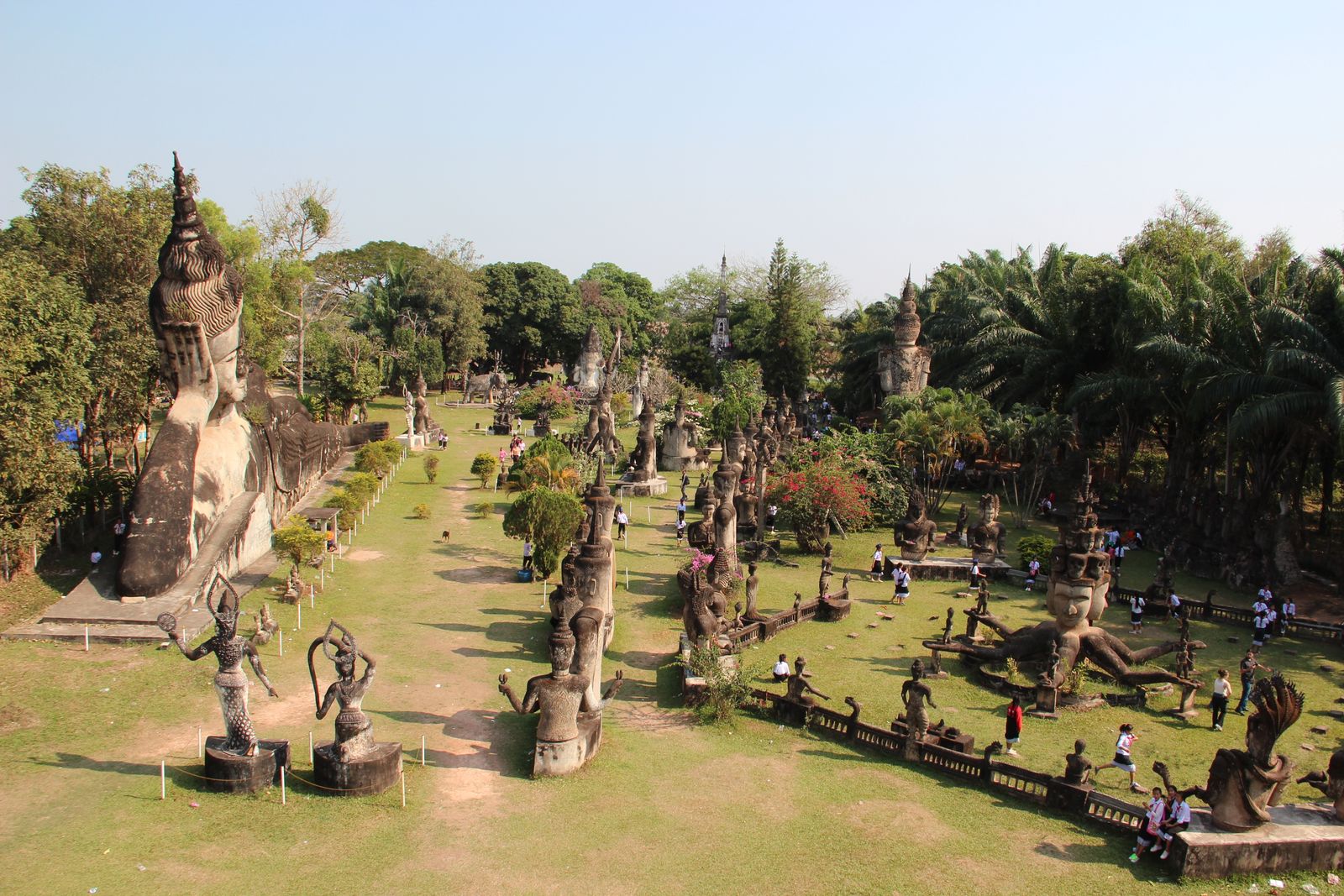
A Buddha lying on his right side runs the length of the central lawn, one of the largest reclining figures in Laos. The calm face and long line of the body are the park's signature image.

📷 Low angle from the feet for depth; late afternoon side-light picks out the robe folds.

Hindu

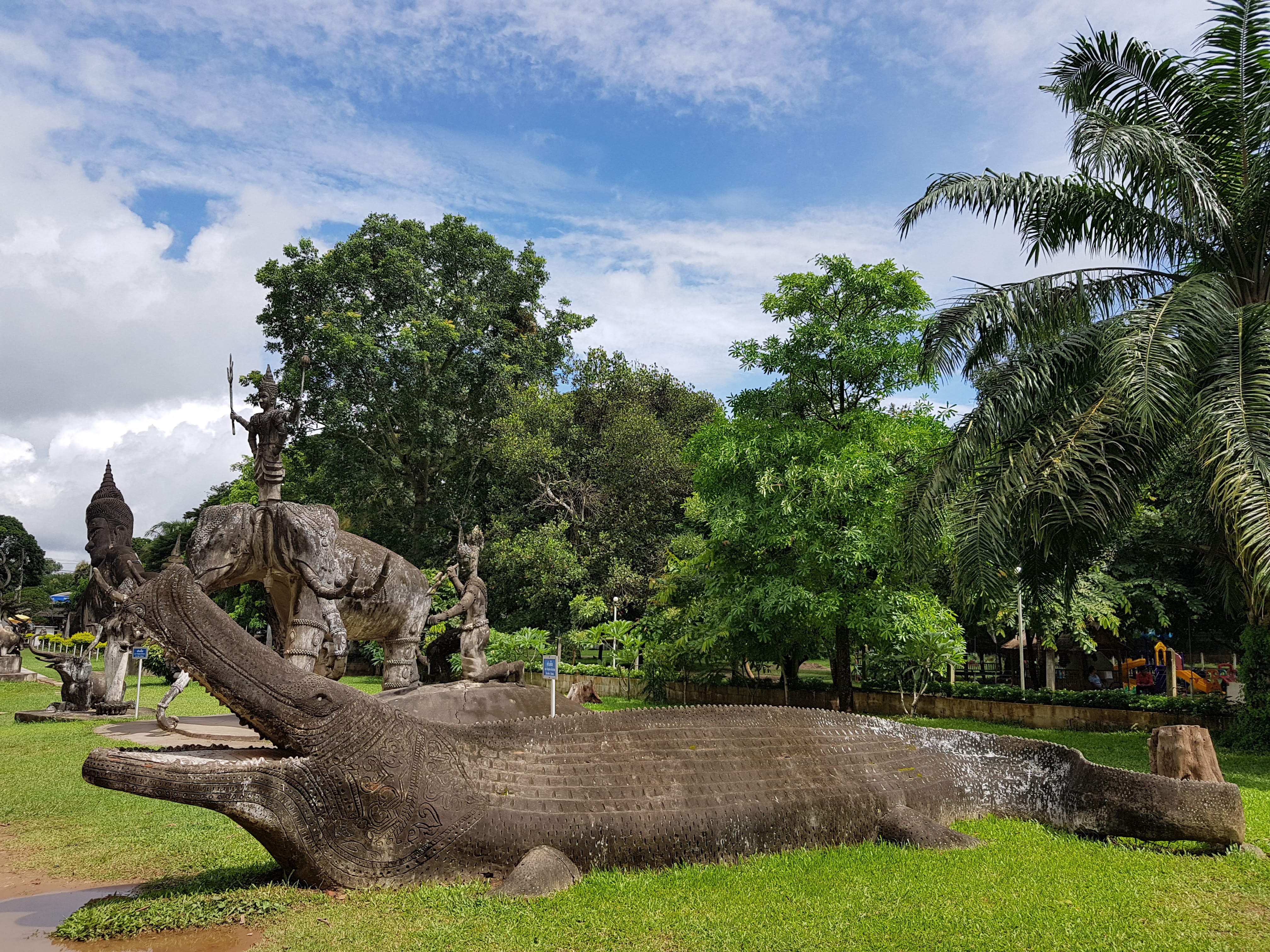
Three-headed Elephant (Erawan)

Erawan carrying Indra

The three-headed mount of Indra, covered in small carved faces. It stands for the meeting of Hindu and Buddhist imagery that defines the whole park.

📷 Stand slightly below the heads and shoot wide — the scale reads much larger than in a straight-on frame.

Hindu

Shiva

The destroyer & transformer

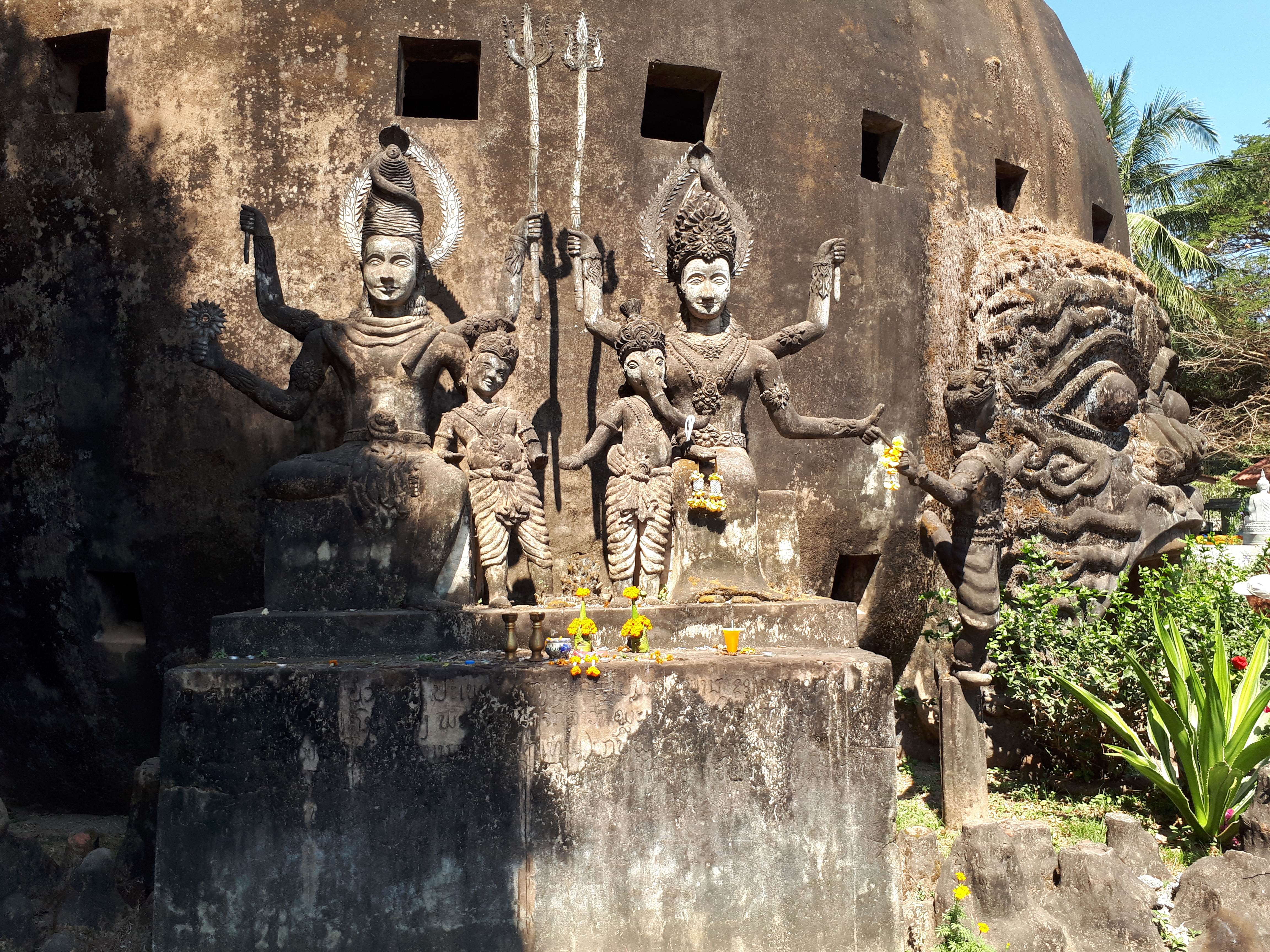
Shiva appears with the attributes of destruction and renewal, a reminder that Luang Pu Bunleua Sulilat drew freely on both Hindu and Buddhist sources.

📷 Frame the upper body against open sky to keep the concrete detail clean.

Hindu

Vishnu

The preserver

Vishnu, the preserver, is shown with his traditional emblems. He balances Shiva on the same lawn — the two faiths literally side by side.

📷 Morning light from the east softens the concrete and avoids harsh shadows.

Epic

Arjuna

Hero of the Mahabharata

Arjuna, the archer hero of the Mahabharata, is among the epic figures cast here. Scenes from the Indian epics sit alongside the Buddhist statues without hierarchy.

📷 Shoot from a low angle with the bow arm leading into the frame.

Statue details and names follow the widely used park descriptions; local guides sometimes give different names for the same figure.

Getting there

Bus 14 and every other way in

Buddha Park sits about 25 km east of central Vientiane on Thadeua Road, close to the Thai–Lao Friendship Bridge. Here is exactly how to get there.

Cheapest

Bus No. 14 — the classic route

Fare
Around 6,000 LAK one way
Frequency
Roughly every 15–20 minutes
Duration
About 45–60 minutes
  1. 1 Start at Talat Sao (Morning Market) bus terminal in central Vientiane
  2. 2 Board Bus No. 14 heading out on Thadeua Road (Route 13 south)
  3. 3 The bus runs east past the turn-offs toward the Friendship Bridge
  4. 4 Ride to the final stop — Buddha Park is right by the road
  5. 5 Return the same way; the last buses leave in the late afternoon

⚠️ Fares and timetables change without notice — confirm at the terminal before you board.

Other ways to reach the park

Tuk-tuk or chartered car

Small groups, door to door

Agree the round-trip price and waiting time in writing before departure; ask the driver to wait or fix a pick-up hour.

Negotiate — round trip with waiting time

Ride-hailing apps (Loca, KokKok Move)

Clear upfront pricing

Coverage is strongest in central Vientiane and thinner near the park. Pin your pick-up at the park gate for the return trip.

App-quoted fare

Rented motorbike

Independent riders

Follow Thadeua Road east for about 25 km. Traffic is mixed and the surface changes; wear a helmet and ride in daylight.

Daily rental plus fuel

Tour or hotel shuttle

Hassle-free half day

Many Vientiane guesthouses run or book a half-day trip that pairs Buddha Park with other eastern sights.

Varies by operator

Coming straight from the Thai–Lao border

The park is only a short ride from the First Thai–Lao Friendship Bridge, which makes it the natural first stop after crossing from Nong Khai.

  1. Clear Lao immigration and visa-on-arrival at the bridge
  2. Take a shuttle or taxi to the Vientiane side
  3. Continue about 10 minutes by road to the park entrance

Check current visa-on-arrival rules and fees with official Lao immigration before you travel.

Prices and timetables are indicative and change often. Treat them as planning guidance and confirm locally on the day.

Park map

Where everything sits

A simple orientation sketch — the park is compact, and you can walk the whole loop in well under an hour.

Mekong River Thadeua Road 1 2 3 4 5 6 7
  1. 1 Park entrance & ticket gate
  2. 2 Giant Pumpkin (climb to the rooftop)
  3. 3 Reclining Buddha
  4. 4 Three-headed elephant (Erawan)
  5. 5 Riverside restaurant & shade
  6. 6 Restrooms
  7. 7 Bus 14 stop on Thadeua Road

Sketch is a simplified orientation guide and is not drawn to scale.

Currency

LAK converter

Lao kip moves against other currencies, and park fees are quoted in kip. Convert before you go.

LAK

Converted

USD

THB

CNY

Loading rates…

💡 Carry small kip notes for the entrance fee, bus fare and market snacks.

Weather

Weather & when to go

Live conditions at the park's coordinates, with a seven-day outlook, so you know what to pack.

Weather alert
  • Thunderstorms are forecast. Stay off open ground, tall isolated trees and the exposed riverbank — and skip the metal stair inside the pumpkin tower.
Right now
25°
Thunderstorm
Feels like
29°
Humidity
93%
Wind
Gentle breeze · 3 Bft
Rain chance
94%
UV index
1 · Low
Today
High 29°
Low 24°
Sunrise 05:56
Sunset 18:12

Sun and shower times are calculated for the park's own coordinates.

What to bring
What to wear

Showers are passing through — quick-drying clothes and shoes with grip are the practical choice.

How to plan

Storms usually build in the afternoon — come early and be ready to cut the visit short. The tower rooftop is no place to be in a storm.

What to bring
  • 🎒 Folding umbrella

7-day outlook

Today
Thunderstorm
29° 24°
💧 94%
Tue
Thunderstorm
27° 23°
💧 80%
Wed
Thunderstorm
29° 23°
💧 97%
Thu
Showers
28° 23°
💧 95%
Fri
Light drizzle
30° 23°
💧 98%
Sat
Thunderstorm
31° 23°
💧 82%
Sun
Thunderstorm
31° 23°
💧 66%

History

History & Significance of Buddha Park (Wat Xieng Khouane Luang)

From a monk's vision to a riverside park

The story of Buddha Park is the story of one man's unusual faith — built in concrete on the banks of the Mekong.

Luang Pu Bunleua Sulilat

In 1958 the mystic figure Luang Pu Bunleua Sulilat founded the park. No ordinary monk, he was a shamanic recluse who blended Hinduism and Buddhism — legend says that as a young man he fell into a cave and was tutored by a Hindu hermit, setting him on a spiritual path outside orthodox religion, fusing the two faiths into one riverside garden.

A garden of two faiths

Over the following years more than 200 figures were cast in concrete — Buddhas, Avalokiteshvara, Shiva, Vishnu, Brahma, Rama and Hanuman sharing the same lawns.

Today

After decades the park remains a relaxed, slightly surreal stop on Vientiane's eastern edge, drawing travellers who cross the river from Thailand's Nong Khai.

A sister park across the river

In 1975, as Laos came under communist rule, Bunleua Sulilat crossed the Mekong to Thailand. In Nong Khai he built Sala Keoku — a sibling sculpture park born of the same vision. One river, two banks, two parks shaped by the same hand.

Up close
Wide view
Wide view
Up close

Drag the slider to compare the park's wide view and a statue up close

The meaning of 'Xieng Khouane'

Locals call it Wat Xieng Khouane. In Lao, Xieng means 'sacred city / city' and Khouane means 'soul / spirit', so the full name translates as 'City of Spirits'. It marks the park's identity as a 'city of statues' while hinting at the animist folk beliefs woven through it.

Did you know?

The giant Pumpkin Tower (also the 'Three Realms Tower') is a three-storey sphere that mirrors the Buddhist cosmology of the 'Three Realms (Traiphum)': enter through a demon's mouth, climb narrow steps in the dark through Hell and the human world, and finally emerge into light at the top — overlooking the whole spirit-city by the Mekong, a symbol of transcending the cycle of rebirth.

Concrete Brutalist Aesthetics

These colossal figures were not finely carved in marble but cast on-site in industrial reinforced concrete. The raw textures and exaggerated proportions express a mid-20th-century Lao folk-art brutalism that is rough yet full of vitality — giving Buddha Park its one-of-a-kind surreal landscape.

A place of spirits

In Lao folk belief the Mekong is home to spirits (Phi). Small shrines near the water ask for safety and luck — a quiet tradition elders still remember.

A note on respect

If you see a small shrine or offerings by the water, admire from a distance and do not disturb them.

A mystic fate across one river

In 1975 Luang Pu crossed the Mekong to Nong Khai, Thailand, and built the sister park Sala Keoku. One master, two parks, facing each other across the river.

Stories & legends

The tales behind the statues

Part history, part folklore — the stories that locals and long-time guides still tell about this riverside garden.

Documented

The man who built a city of spirits

Bunleua Sulilat was not an ordinary monk. A mystic and shamanic healer, he had studied under a hermit and spent years travelling before settling on this bend of the Mekong in 1958. With a handful of untrained local workers he began pouring reinforced concrete into moulds, and kept going for years.

Legend

The cave and the hermit

The best-known story says that as a young man Bunleua fell into a cave and met a Hindu hermit who taught him scripture and meditation. That encounter, the tale goes, is why the park mixes Buddhist and Hindu figures so freely — a claim repeated by guides, though no source confirms the details.

Documented

One river, two parks

After 1975 Bunleua crossed the Mekong to Nong Khai in Thailand and began again, creating Sala Keoku. The two gardens face each other across the water, built by the same hand and the same vision — a rare case of one artist's work straddling two countries.

Symbolism

Hell, earth and heaven in one sphere

The giant pumpkin is a textbook image of the Buddhist 'three realms'. You enter through a demon's mouth, grope up narrow dark stairs past scenes of hell and the human world, and surface at the top into daylight — a walk-through metaphor for leaving the cycle of rebirth.

Legend

Spirits of the Mekong

In Lao folk belief the river is inhabited by phi, spirits who must be treated with courtesy. Small shrines and offerings near the water ask for safe passage and good fortune — a quiet practice that long predates the sculptures.

Documented

Concrete, not marble

Nothing here was carved from fine stone. The figures were cast on site in industrial reinforced concrete by workers with no formal training — which is why the surfaces are raw and the proportions wildly exaggerated. What began as thrift became the park's signature look.

Documented

A name that means 'city of spirits'

Xieng means city, khouane means spirit or soul. Wat Xieng Khouane — the City of Spirits — describes the place exactly: a settlement of concrete beings standing where the Mekong bends.

Documented

A garden that keeps changing

Exposed to monsoon rain and tropical sun, the concrete weathers and cracks. Repair work is continuous, and some figures have been re-cast over the decades. What you see is not a finished monument but a garden still being looked after.

Legends are labelled as such; they are shared as cultural tradition rather than documented fact.

Seasonal strategy

When to visit: a season-by-season plan

Vientiane has three clear seasons, and each changes what a morning at the park actually feels like.

Cool & dry
Nov – Feb
Typical conditions
25–31°C, low humidity, mostly clear skies
Crowds
Busiest
How to plan
The best all-round window. Arrive at opening for soft light and cool air, stay on for a Mekong sunset, and expect company at the pumpkin staircase.
Hot
Mar – Apr
Typical conditions
33–38°C, hazy afternoons, burning season
Crowds
Moderate
How to plan
Visit before 10:00 or after 16:00. Carry water, rest under the trees, wear a hat — the concrete lawns radiate heat at midday.
Rainy
May – Oct
Typical conditions
28–33°C, humid, frequent afternoon storms
Crowds
Quietest
How to plan
Mornings are usually dry, so go early. The lawns turn green and the river runs high, but count on a downpour after lunch in the wettest months.

Month by month

  • Jan
    Cool, dry, clearest light
  • Feb
    Warm days, still comfortable
  • Mar
    Heat builds, haze begins
  • Apr
    Hottest month; go early
  • May
    First storms, valley turns green
  • Jun
    Regular rain, very quiet
  • Jul
    Wettest period, high river
  • Aug
    Lush and muddy, few visitors
  • Sep
    Peak river, dramatic skies
  • Oct
    Rains ease, humidity lingers
  • Nov
    Cool season begins
  • Dec
    Pleasant days, busy holidays

The table reflects the region's long-term climate patterns; individual days can differ.

Suggested routes

Routes for every kind of visitor

Every route starts at the main gate. Choose by how much time you have — and by who you are travelling with.

Classic routes

Half day 2 – 3 hours

The standard visit: the highlights, a climb, and a cold drink by the river.

  1. 1 Enter and take the main lawn clockwise toward the three-headed elephant
  2. 2 Climb the giant pumpkin from the demon's mouth up to the rooftop
  3. 3 Walk the length of the reclining Buddha
  4. 4 Finish with a drink in the shade near the riverbank
Full day 5 – 6 hours

A slower read of the park, with time to sit, sketch and watch the light change.

  1. 1 Arrive at opening and walk the lawns in the cool morning air
  2. 2 Study the Hindu figures — Shiva, Vishnu, Brahma and the Ramayana scenes
  3. 3 Break for noodles and Lao coffee at the café
  4. 4 Return to the riverbank for the herons and the water monitors
  5. 5 Stay for the late-afternoon light on the Mekong before closing

Tailored by traveller type

Families with children

Flat ground, the animals, and the pumpkin — with shade breaks.

  1. Start on the flat lawns; the ground is even and easy for prams
  2. Let children spot the animals — elephant, naga, demons and gods
  3. Take the pumpkin slowly; the inner stair is narrow and dark
  4. Rest on the shaded benches and keep water handy

Photography & nature

Low sun, mist on the river, and the wildlife along the bank.

  1. Be at the gate at opening for side-lit statues and empty paths
  2. Work the reclining Buddha from a low angle, then the elephant wide
  3. Walk the riverbank for herons, kingfishers and water monitors
  4. Return before closing for warm light across the Mekong

Low-energy & step-free

Everything on the ground level, with plenty of places to sit.

  1. Follow the flat main paths — most of the park is reachable without steps
  2. Skip the pumpkin tower; the rooftop view needs a narrow stair
  3. Use the shaded benches between the statue groups
  4. Plan a short 45–60 minute loop and rest at the café

Itineraries

How to fit Buddha Park into your day

Three ready-made plans, from a quick half day to a cross-border first stop.

Half day 3 – 4 hours

Buddha Park and the riverbank

The classic plan: take Bus 14 out in the morning, see the park, and be back in town for lunch.

  1. 1 Bus 14 from Talat Sao in the morning
  2. 2 Walk the main lawn and the six key sculptures
  3. 3 Climb the giant pumpkin to the rooftop terrace
  4. 4 Cold drink by the Mekong before the return bus
Full day 6 – 8 hours

Buddha Park plus eastern Vientiane

Add the Friendship Bridge area and a riverside lunch to make a full day of the eastern side of the capital.

  1. 1 Early start for cooler light and thinner crowds
  2. 2 Long unhurried walk through the sculpture lawns
  3. 3 Lunch at a riverside restaurant near the park
  4. 4 Continue toward the Friendship Bridge before returning
Cross-border First stop on arrival

Straight from Nong Khai

Cross the Mekong from Thailand and visit the park on your way into Vientiane — no backtracking.

  1. 1 Cross the First Thai–Lao Friendship Bridge
  2. 2 Complete Lao entry formalities
  3. 3 Short road transfer to the park
  4. 4 Continue into central Vientiane afterwards

Build in extra time on public holidays, when both the border and the park are busiest.

Riverbank & nature

Life along the Mekong

“A quiet garden by a living river — treat it as you would a temple.”

Buddha Park sits on the edge of the Mekong. Mornings bring mist off the water; the lawns and shaded trees are home to birds and lizards between the statues.

Weather & the river

Cooler mornings

The river breeze keeps the park pleasant before the midday heat.

Lotus & shrubs

Ponds and borders filter the air and shelter small creatures.

Seasonal water

The Mekong rises in the wet season (May–Oct) and falls in the dry.

Plants in the park

Lotus

Sacred in Buddhism, blooming at dawn on the still ponds.

  • Pink lotus — Common around the quiet southern ponds
  • White lotus — Opens midday, folds before dusk
Shade trees & grass

Big trees cool the lawns where visitors rest.

  • Rain tree — Wide canopy, popular shade at noon
  • Bamboo — Rustles in the river breeze

Wildlife you might see

  • Herons stalking the shallows
  • Water monitors on the bank
  • Dragonflies over the ponds
  • Kingfishers along the river
  • Small turtles near the water's edge

Leave no trace

Help keep the park clean for the next visitor and for the local community.

Tick off each item as you walk — small acts keep a 200-statue park peaceful

What to look for by season

Things to spot through the year

Lotus bloom

🗓 Year-round, best at dawn

Common in calm water

Water monitor

🗓 Cool mornings

Fairly common

Kingfisher

🗓 After rain, May–Oct

Common in wet season

Food & drinks

Eat by the river

The park keeps it simple — a few stalls and a café rather than a night market.

🥤
Coconut water & drinks ~10,000 LAK

Cold drinks from the stalls — welcome in the midday heat.

🍌
Sticky rice & snacks ~15,000 LAK

Local snacks and fruit near the entrance.

🍜
Noodle soup ~25,000 LAK

A simple pho-style bowl at the small café.

Lao coffee ~15,000 LAK

Sweet iced coffee to round off the walk.

Eat by the river
“The best break at Buddha Park is a cold drink under the shade trees.”
— a regular visitor

Visitor services

Facilities & nearby services

What to expect in and around the park — listed by type only. We do not recommend or promote any individual business.

Restrooms

Public toilets are located near the entrance. Carry your own tissue and a little small change.

Parking

Open-air parking for cars, tour vans and motorbikes sits by the gate. Shaded spaces fill early on weekends and holidays.

Food & drinks

A small café and a few stalls serve noodles, snacks, fruit and cold drinks. Prices are modest and cash is easiest.

Places to stay

There is no accommodation inside the park. Guesthouses and hotels are concentrated in Vientiane centre, about 25 km away.

Shops & groceries

Small convenience stalls near the entrance sell water and basic sundries. For a full supermarket, stock up in the city first.

Fuel & charging

Fuel stations and motorbike repair shops line the Friendship Bridge road. Charging points for electric vehicles remain rare — plan your range before driving out.

Pharmacy & medical

Basic medicines are sold in the city; for anything serious, hospitals and clinics are in Vientiane centre.

Cash & ATMs

Bring Lao kip in small notes for tickets, camera fees and snacks. ATMs are in Vientiane and near the Friendship Bridge, not inside the park.

Shade & rest

Shaded benches and open lawns give you somewhere to sit down out of the midday heat.

Connectivity

Mobile data covers most of the park. Wi-Fi, where offered at the café, can be slow.

Facilities are run by different operators and may change seasonally; ask at the gate when you arrive.

Reviews

What visitors say

A snapshot of Google Maps user reviews for Buddha Park (Wat Xieng Khouane Luang) in Vientiane, Laos — kept on this page only and not submitted as structured data.

★★★★☆ 4.3 Based on Google Maps user reviews · not endorsed by Google

Synced from Google Maps user reviews, last synced September 2026; copyright belongs to the original authors and Google Maps. View all reviews on Google Maps →

“A surreal, peaceful garden you won't find in any guidebook — statues, river and good light”
★ 5.0 · traveller review
“Climbing the giant pumpkin at sunset was the highlight of our Vientiane trip”
★ 5.0 · visitor note
★★★★★
Must-see: giant pumpkin

Weird and wonderful — climb it for the rooftop view

Ana Mar 2026
★★★★★
Reclining Buddha

Huge and calm — easy to spend an hour here

Tom Feb 2026
★★★★☆
Morning visit

Cool and quiet before the tour buses

Lina Jan 2026
★★★★☆
Family

Flat paths, kids loved the elephant

Wei Feb 2026
★★★★★
Photography

Soft morning light on the statues was worth the early start

Ken Dec 2025
★★★★☆
Riverside

Felt authentic, fewer crowds than city temples

Sora Jan 2026
★★★★☆
Food

Cheap drinks and snacks, bring cash

Pim Mar 2026
★★★★☆
Crowds

Busy on holidays, weekdays are calmer

Dan Feb 2026

Understanding & care

What this place is — and your part in it

Buddha Park is a working religious site as well as an attraction. A little background makes the visit richer, and a little care keeps it standing.

Why the park matters

A record of folk imagination

The figures were designed by one mystic and built by workers with no formal art training. That makes the park a rare, unfiltered record of mid-20th-century popular religious imagination in the Mekong valley.

Concrete as a medium

Industrial reinforced concrete was cheap and available. It allowed enormous forms at speed, but it also means the sculptures weather quickly — which is why the surface you see is partly original, partly repair.

Two traditions on one lawn

Buddhist and Hindu figures stand side by side, along with animist spirit beliefs older than either. The park is a physical map of the religious layering that characterises Laos.

Still a place of worship

People come to make offerings, not only to take photographs. Monks and caretakers work here; the shrines are used.

What helps

  • Dress modestly — shoulders and knees covered
  • Remove shoes where a sign or a local asks you to
  • Keep your voice low near shrines and people praying
  • Carry your rubbish out if bins are full
  • Ask before photographing people, including monks
  • Pay the posted fees at the gate — they fund upkeep

What to avoid

  • Climb on the statues or step over the barriers
  • Sit on or lean against religious figures for a photo
  • Touch or move offerings left at shrines
  • Bring drones without written permission
  • Let children run uncontrolled on fragile concrete
  • Discard anything into the river

The park has no ticket revenue from this site and receives no commission of any kind. It survives because visitors treat it with care — please help keep it that way.

Sources

Our references

This non-commercial guide compiles public information to help visitors plan responsibly.

Image credits

Facts & data

Ratings, hours and coordinates are compiled from public sources and may change — please verify on site before you go.

Reviews · last synced September 2026

Synced from Google Maps user reviews, last synced September 2026; copyright belongs to the original authors and Google Maps.

View all reviews on Google Maps ↗

Found a mistake?

We're a small non-commercial team. If something is wrong or outdated, let us know and we'll fix it.

Email us

All photos displayed on this website remain the property of their original photographers; all image rights and copyright belong to them.

© 2026 Buddha Park guide · non-commercial visitor resource

Location & map

Location & Map of Buddha Park (Vientiane, Laos)

Find Buddha Park

In Deua village, Thanon Tha District, on Vientiane's eastern edge by the Mekong, near the Thai–Lao Friendship Bridge.

Rating
4.3 ★
from 5,456 reviews

📍 Deua, Thanon Tha District, Vientiane, Laos

🧭 Plus Code WQ67+WW Vientiane

🌐 17.9124°N, 102.7622°E

Opens
08:00
daily
Area
Deua
Vientiane, Laos